Seated Incline Cable Fly . How to do seated cable fly. Maintain full control of the cables at all times. Pectoralis major Exercises & Workouts from www.freetrainers.com Do not let the weight stack drop when your lower. The decline bench cable fly is performed as follows: Incline bench cable fly exercise.
Pandas Find First Row With Value. 0 true 1 true 2 false 3 false dtype: First_value = df['btime'].values[0] this way seems to be faster than using.iloc :
Pandas DataFrames 101 from codingnetworker.com
As an example, consider the following dataframe: Get first row value of a given column in pandas dataframe. Get the specified row value of a given pandas dataframe select rows & columns by name or index in pandas dataframe using [ ], loc & iloc decimal functions in python | set.
We Can Obtain The Actual Index By Accessing The Name.
Groupby ([ 'region' , 'area' ]). Find value of first occurrence in following rows after certain value in row in pandas. An option to let you iterate rows and stop when you're satisfied, is to use the dataframe.iterrows, which is pandas' row iterator.
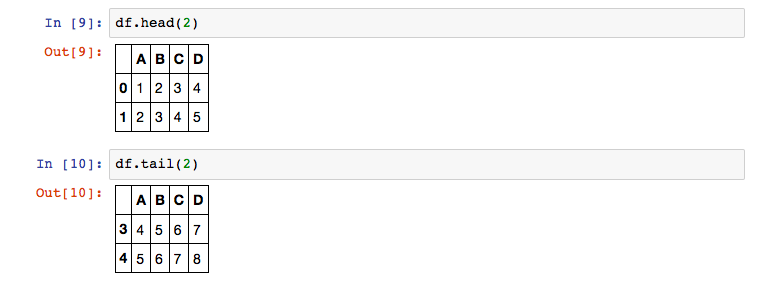
Jul 12, 2019 · For Checking The Data Of Pandas.dataframe And Pandas.series With Many Rows, Head() And Tail() Methods That Return The First And Last N Rows Are Useful.
The syntax is like this: This will give us the first row that meets our condition. By eyeballing the dataframe, we notice two values are close.
One Way Would Be To Use Cumsum To Help Find The First:
You can use one of the following methods to select rows in a pandas dataframe based on column values: I have tried using the. Note the square brackets here instead of the parenthesis ().
0 True 1 True 2 False 3 False Dtype:
To get the first value in a group, pass 0 as an argument to the nth () function. Here we will search the column name with in the dataframe. I would like to find the value of the first occurrence after certain value in row.
Df [Df [‘Column_Name’] == Value_You_Are_Looking_For] Where Df Is Our Dataframe.
Here, the distance is how far away each row is from the previous value of '1' in the active column, with the distance being the number of business days. First_value = df['btime'].values[0] this way seems to be faster than using.iloc : Select rows where column is equal to specific value.


Comments
Post a Comment